Two of my clients’ biggest challenges, particularly business owners, are time management and improving productivity. When you feel busy all day long, it can take time to pinpoint the sources of lost time in your schedule. If that sounds like you, the Eisenhower Priority Matrix might be the secret to better managing your time.
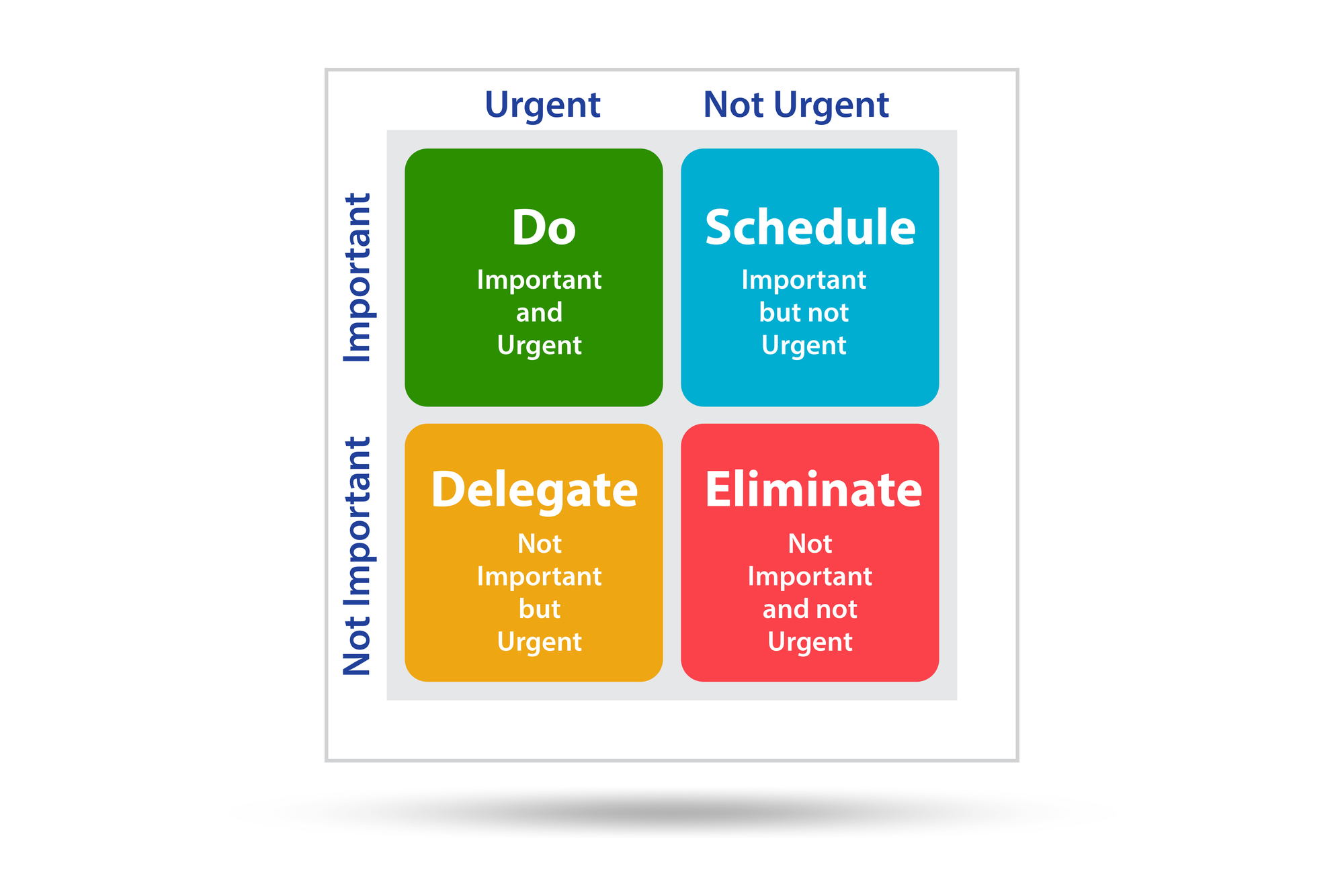
The Eisenhower Priority Matrix is a time management tool that can help you prioritize tasks by categorizing your to-do list into four quadrants based on each item’s urgency and importance. This allows you to see where your time is going at a glance.
The matrix was named after former president Dwight D. Eisenhower, who once said, “I have two kinds of problems: the urgent and the important. The urgent are not important, and the important are never urgent.”
It was made famous by author Steven Covey in his book The 7 Habits of Highly Effective People. The matrix divides tasks into four categories: urgent and important, urgent but not important, not urgent but important, and not urgent and not important.
These are critical tasks with deadlines and other issues that need to be resolved immediately, and you’ll handle them. Although this quadrant is for emergencies and sudden surprises, all work should be high-level. Don’t get derailed by tasks that only feel important.
These tasks might be longer-term projects, planning for the future, strategizing, personal growth, continuing education, relationship-building, and other vital tasks that can be done at a later date.
These are usually interruptions—calls, emails, drop-ins, and even some meetings. They often pop up because someone on your team needs an answer for a task that might be urgent and important to them, but is not an emergency for you.
I used to believe that I had to be involved in every detail and that my team would value me much more if I were the be-everywhere answer man. While it was a dopamine hit for me, I significantly handcuffed my team’s learning and development by immediately reacting to everything. I was mistaken earlier, and I want to make sure you don’t make the same mistakes.
In the last quadrant are either frivolous tasks that you may enjoy but don’t add value to your company, or busy work tasks that would be best delegated to someone else or abandoned altogether.
I’ve prepared a downloadable version of the matrix to help you organize your tasks into these categories. By plugging your daily or weekly to-do list into the four quadrants, you can grasp where the bulk of your time should be spent during your work week.
First, get everything out of your head and onto paper. Take a few minutes to brainstorm every task, project, and responsibility currently on your plate, big or small. Include things coming down the pipeline in the near future. A complete list prevents work from slipping through the cracks and gives you the full picture you need to start prioritizing.
For each item on your list, ask two questions: “Is this important?” and “Is this urgent?” Really think about this and be honest in your answers. Resist the instinct to label everything as either urgent or important or both. Most tasks are not as pressing as they feel.
Using my downloadable Eisenhower Priority Matrix template, organize your tasks into the four quadrants. After that, prioritization becomes much more manageable. Having a visual guide is a good reminder of where your time is currently going and where it should be spent.
Now you can take action. Get started on your quadrant 1 tasks right away, then schedule quadrant 2 tasks for a more convenient time. Anything in quadrant 3 should be assigned to someone else to tackle, while tasks in quadrant 4 should likely be deleted entirely. Rinse and repeat week after week.
The Eisenhower Matrix is a time-management exercise that helps you sort the tasks on your to-do list into four quadrants based on their urgency and importance, allowing you to decide what to do first, schedule for later, delegate to someone else, or eliminate them entirely.
First, make a list of all the tasks on your to-do list. Next, evaluate each one for urgency and importance. Place each task in its corresponding quadrant, then take the appropriate action for each category (complete, schedule, delegate, or delete). The entire organization process can be done in under 20 minutes.
The four quadrants of the Eisenhower Priority Matrix can be broken down as follows.
The matrix works because it forces you to separate what feels urgent from what is actually important, which is a distinction many people never take the time to make. This steers you away from reactive firefighting and towards a more proactive approach. Ideally, using the matrix over time reduces the number of quadrant 1 crises and allows you to spend more time in quadrant 2.
Want more great productivity tips like the Eisenhower chart? I publish weekly articles about time management, leadership, and much more. Sign up for my email list to deliver each new article straight to your inbox. If you’re looking for a business coach to help you set priority levels in your business, fill out my contact form to schedule a free consultation
Coach Dave
Brian Tracy is a world-renowned writer, public speaker, and consultant. He is listed as the…
Over the years of coaching business owners, I’ve seen a growing trend: the rise of…
I don’t know anyone who says they’ve never felt stress at work. Even the best…
So you’ve just been promoted. Congratulations! You now have the opportunity to become a better…
What makes a good leader? For a long time, as an executive and business coach,…
For years, I have been encouraging my clients to clearly identify what is preventing their…